Part 5 – From Bank Account to Bank Account: How a Hybrid Payment Actually Moves
31 August 2026
What does a stablecoin payment actually look like for a company that neither holds stablecoins nor wants to?
Consider a German technology company that needs to pay a Brazilian service provider. The invoice is for BRL 750,000. The German company manages its treasury primarily in euros, while the Brazilian company simply wants Brazilian reais credited to its normal bank account.
From the perspective of the two companies, this should be straightforward. The German company approves the invoice and initiates the payment; the Brazilian company receives BRL 750,000. Neither company should need to care very much about what happens in between.
Yet what happens in between is precisely where cross-border payments become complicated. Money may have to move between currencies, banks, payment providers and settlement networks. Compliance controls have to be satisfied, foreign exchange executed, liquidity found in the destination market and the final payment delivered through local banking infrastructure. Afterwards, the entire transaction needs to be reconciled and recorded.
The emergence of stablecoins creates another way of completing part of that journey. Instead of moving value internationally entirely through correspondent banking, a payment can begin in conventional bank money, use a stablecoin for the international settlement leg, and return to conventional bank money before reaching the beneficiary. This is what we mean by a hybrid payment.
Following the money from Germany to Brazil
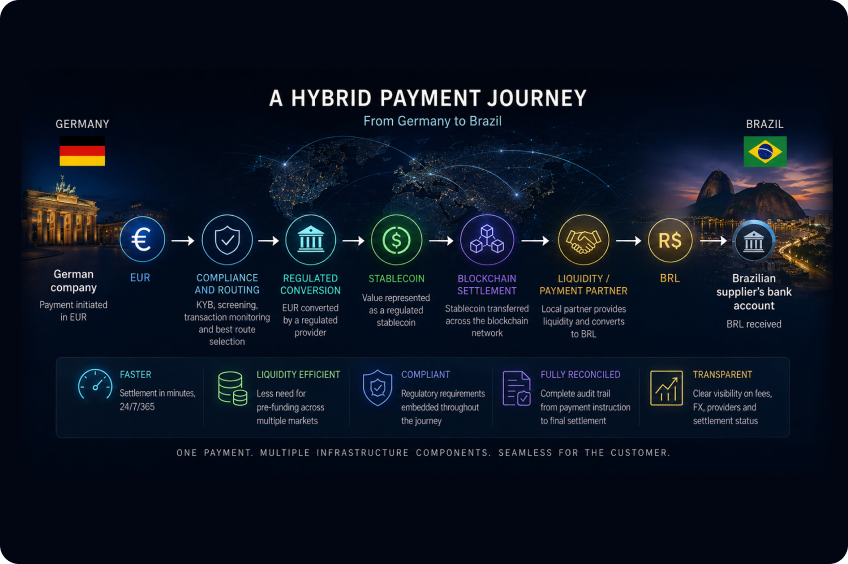
Our German company starts with euros in its normal bank or payment account. It does not hold Brazilian reais and, importantly, it should not need to buy and manage stablecoins, choose a blockchain or establish its own relationship with a digital-asset liquidity provider. Its instruction is much simpler: use our EUR liquidity to pay this company BRL 750,000.
Before anything moves, the transaction has to satisfy the necessary compliance requirements. Depending on the institutions involved, this can include KYB and KYC controls, sanctions screening, transaction monitoring and source-of-funds checks. If a digital asset is used in the settlement chain, wallet screening and other blockchain-specific controls may also be required. Moving part of a transaction onto a blockchain does not make these requirements disappear; the digital rail has to operate within the same broader regulated financial environment.
The infrastructure can then determine how the payment should be executed. A conventional international bank transfer may be the best route. But suppose that, for this particular transaction and corridor, stablecoin settlement offers an advantage in speed, availability or liquidity. The euros can then be converted through an appropriate regulated provider into a suitable stablecoin.
This does not mean that the company’s treasury department suddenly becomes a crypto operation. The stablecoin can exist entirely within the payment infrastructure as an intermediate settlement asset. The company starts with EUR and instructs a payment in BRL; what happens between those two currencies can largely remain behind the scenes.
In other words, the company is not making a “crypto payment”. It is making a cross-border payment in which a digital asset happens to provide one part of the settlement infrastructure.
The stablecoin is then transferred across a blockchain network to the destination side of the transaction. This particular part of the journey can happen very quickly and can operate outside conventional banking hours. But it is important not to confuse a fast blockchain transaction with a completed cross-border payment. The Brazilian beneficiary has not yet received anything. The stablecoin still needs to become Brazilian reais and those reais need to reach the beneficiary’s bank account.
This is where liquidity providers and local payment partners become important. A provider on the destination side needs access to BRL liquidity and the ability to convert the settlement asset into local currency. The resulting reais can then be paid through Brazilian payment infrastructure into the beneficiary’s ordinary bank account.
The Brazilian company receives BRL, not a stablecoin. It does not need a wallet, understand blockchain technology or change its accounting processes. From its perspective, it has simply received a local payment into its bank account.
The complete journey could therefore look like this:
That is one of the more interesting characteristics of hybrid payment infrastructure. Digital assets can be used in the middle of a transaction without requiring either the payer or beneficiary to operate primarily in digital assets.
The payment does not end when the money arrives
There is another part of the transaction that receives much less attention than the blockchain transfer: reconciliation. For a corporate treasury department, moving the money is only part of the job.
The German company needs to know which invoice was paid, how much EUR was used, which FX rate was applied, what fees were charged and whether the beneficiary received the correct BRL amount. Finance may need the identity of the providers involved, settlement confirmations and transaction references. Compliance needs an audit trail, while accounting needs a transaction record that can be matched against the company’s books.
A hybrid transaction can potentially involve several providers, currencies and ledgers. Unless those elements are brought together, a payment that took seconds to settle can still create hours of administrative work afterwards. The value of the infrastructure therefore lies not only in moving money faster, but in making the complete transaction coherent from instruction through settlement to reconciliation.
This also illustrates why a stablecoin by itself is not a payment infrastructure. The blockchain may provide an efficient mechanism for moving value between two points, but someone still has to manage everything around that movement: compliance, conversion, liquidity, routing, local payout, transaction records and reconciliation.
Making complexity invisible
This is where orchestration becomes important. The German company should not have to decide which blockchain to use, which stablecoin provides the appropriate liquidity, which provider should perform the conversion or which local partner should deliver BRL to the beneficiary.
Those are infrastructure decisions. The payment platform should coordinate the appropriate combination of rail, asset, provider, currency and settlement method without requiring the corporate customer to manage the underlying complexity.
This is the role Atlas is designed to support. Atlas connects traditional payment infrastructure with digital-asset settlement and the regulated and commercial providers required to move between them. Banks, payment institutions, liquidity providers and other participants continue to perform their respective roles, while the technology provides the connectivity needed to make the transaction work as a coherent whole.
The objective is not to put every payment on a blockchain. For many transactions, existing infrastructure such as SEPA, instant payments or conventional bank transfers will remain the best solution. In other circumstances, using a digital asset for part of the settlement journey may provide an advantage. A genuinely multi-rail infrastructure should be able to use both.
For a CFO or head of treasury, this is ultimately what matters. The objective is not to own a particular payment technology or maximise the number of transactions that touch a blockchain. It is to move money from the company’s existing liquidity to the beneficiary in the required currency, with the right combination of cost, speed, liquidity efficiency, compliance and control.
The best hybrid payment may therefore be one in which the customer barely notices the technology at all. The German company sends euros, the Brazilian company receives reais, and the complexity in between is handled by the infrastructure.