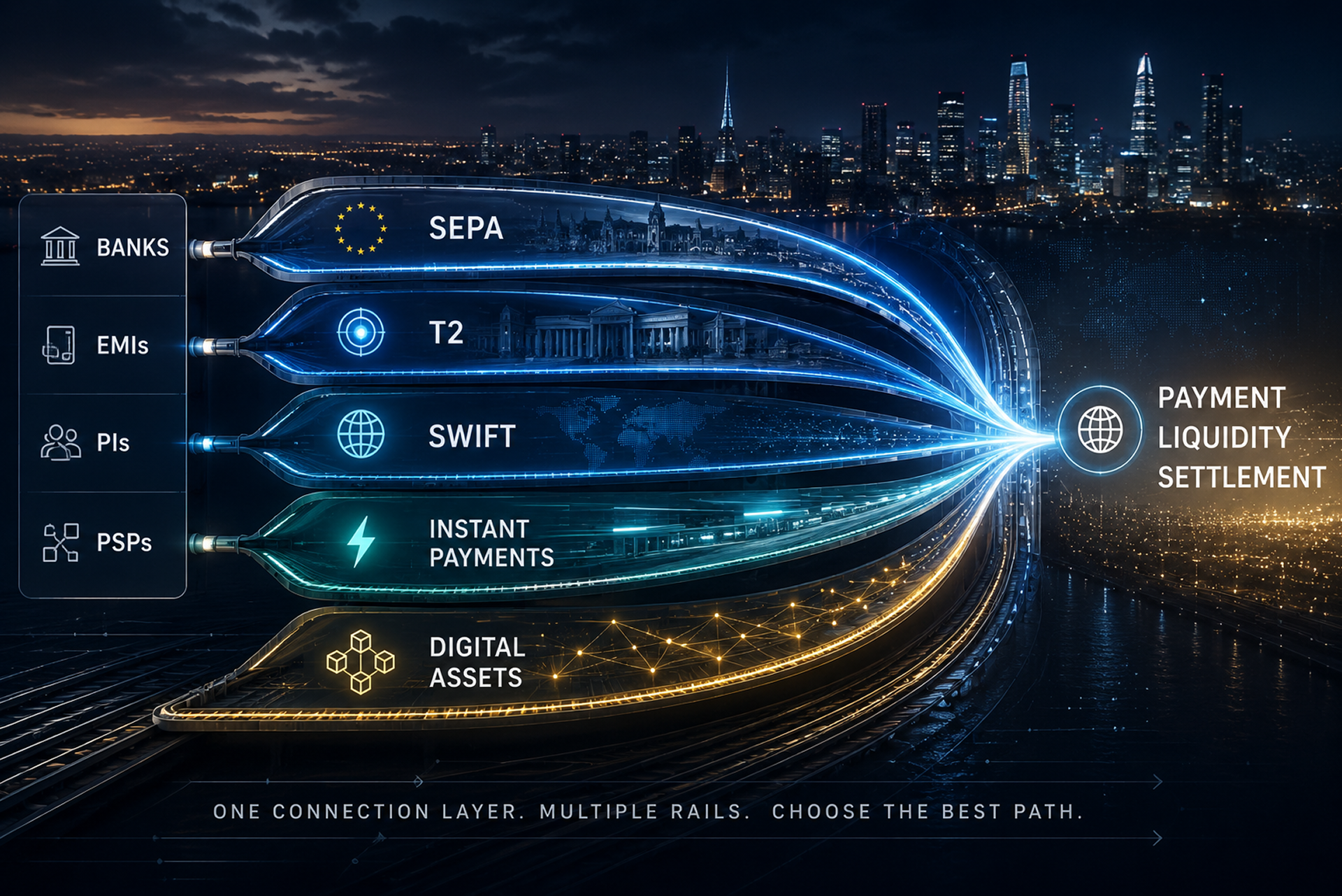
The debate around digital assets has often been framed as a choice between two financial systems: traditional banking on one side and blockchain-based finance on the other. That distinction is becoming increasingly outdated.
The more likely future is hybrid. Bank money, instant payments, card networks, correspondent banking and digital assets will coexist, with different rails being used for different transactions. For banks, Electronic Money Institutions (EMIs) and Payment Service Providers (PSPs), the strategic question is therefore no longer whether digital assets will replace existing payment infrastructure. It is how to connect to new settlement rails when they offer an advantage.
Stablecoins illustrate this change particularly well. Their original association with cryptocurrency trading is giving way to a broader role in payments, treasury and settlement. In the right circumstances, they can move value across borders quickly, operate outside traditional banking hours and provide an alternative route for transferring liquidity between markets. But a stablecoin is not, by itself, a payment infrastructure.
A business making a payment still has to move from its existing funds into the appropriate settlement asset, meet compliance requirements, find liquidity, manage foreign exchange where necessary, execute the transaction and often convert the proceeds back into local currency for the beneficiary. The blockchain transfer may take seconds, while the complete transaction involves a much larger financial ecosystem. This is where digital asset connectivity becomes important.
Adding a rail, not replacing the system
Financial institutions already operate in a multi-rail world. A PSP may use SEPA for one transaction, SWIFT for another, a domestic instant-payment scheme for a third, and card networks for millions more. Each rail has different characteristics in terms of geography, cost, speed, availability and settlement. Digital assets simply add another set of possibilities.
For a euro payment within the euro area, SEPA may remain the obvious choice. In Sweden, a domestic payment may be better handled through an instant-payment solution such as Swish. In certain cross-border corridors, however, stablecoin settlement may offer advantages by reducing delays, enabling 24/7 settlement or improving the use of liquidity.
The objective is therefore not to move every payment onto blockchain infrastructure. It is to add digital asset settlement to the existing range of rails and use it where it provides a genuine advantage.
This distinction matters. Banks, EMIs, PIs and PSPs do not need to become crypto companies to benefit from digital asset settlement. They need infrastructure that allows them to access new rails safely and selectively, while remaining connected to the financial infrastructure they already use.
The challenge is the connection
Connecting these worlds is more complicated than connecting to a blockchain.
An institution may need access to wallets, liquidity providers, exchanges, banking partners and different blockchain networks. It may need to move between euros, dollars and other currencies, as well as between fiat money and different digital assets.
At the same time, the transaction must remain compatible with the institution’s compliance framework. KYB, sanctions controls, wallet screening, transaction monitoring, source-of-funds requirements and audit trails cannot simply disappear because part of a payment moves over a blockchain.
This creates a new infrastructure requirement between traditional financial institutions and emerging settlement networks.
Instead of building and maintaining dozens of separate integrations, institutions need a connectivity layer capable of bringing together rails, assets, liquidity and providers while maintaining control over how transactions are executed.
From connectivity to orchestration
Once several payment and settlement alternatives are available, another question emerges: which one should be used?
A payment from London to Dubai may have several possible routes. Conventional correspondent banking may be appropriate for one transaction, while another could combine bank money with stablecoin settlement and local fiat payout.
Connectivity therefore creates the possibility of orchestration: selecting and coordinating the appropriate route according to the requirements of each transaction.
This is also the role Atlas is designed to support. Rather than asking institutions to abandon their existing payment infrastructure, Atlas provides connectivity between traditional money and digital asset settlement, bringing together the components required to execute hybrid transactions.
A hybrid financial system
The transformation of payments is unlikely to happen through one technology replacing everything that came before it. Financial infrastructure tends to evolve by adding new networks and capabilities to the systems already in place. Digital assets are becoming part of that evolution.
For banks, EMIs, PIs and PSPs, this creates both an opportunity and an infrastructure challenge. Institutions that can connect to multiple settlement rails will have more choices in how they move liquidity and serve their customers. Those choices can increasingly be made according to cost, speed, currency, availability, counterparty and risk. The future of payments is therefore unlikely to be bank money versus digital assets. It will be a financial system capable of using both.
Terminology
- EMI – Electronic Money Institution: A regulated financial institution authorised to issue electronic money and provide payment services.
- PI – Payment Institution: A regulated institution authorised to provide payment services, but not to issue electronic money as an EMI does.
- PSP – Payment Service Provider: A broader term for organisations providing payment services, including banks, EMIs, PIs and other regulated payment providers.