



Part 1 – Why Cross-Border Payments Still Take Too Long
Sending money within your country has become almost effortless. Sending money across the world is a very different story.


Cross-border payments across the world still run on infrastructure and assumptions built for another era. This series explores why moving money across borders remains slow, costly and fragmented - and how a new financial infrastructure is emerging.
From correspondent banking and liquidity to stablecoins, settlement and payment orchestration, we examine how businesses can move money faster, use liquidity more efficiently and choose the best rail, currency and settlement method for every payment.
New instalments will be published regularly.
Sending money within your country has become almost effortless. Sending money across the world is a very different story.

The future of payments will not be built on a single network. The competitive advantage will lie in orchestrating payment rails intelligently.

Stablecoins can move value globally, but corporate treasury still needs infrastructure connecting digital settlement with bank money, FX, liquidity, compliance and reconciliation.
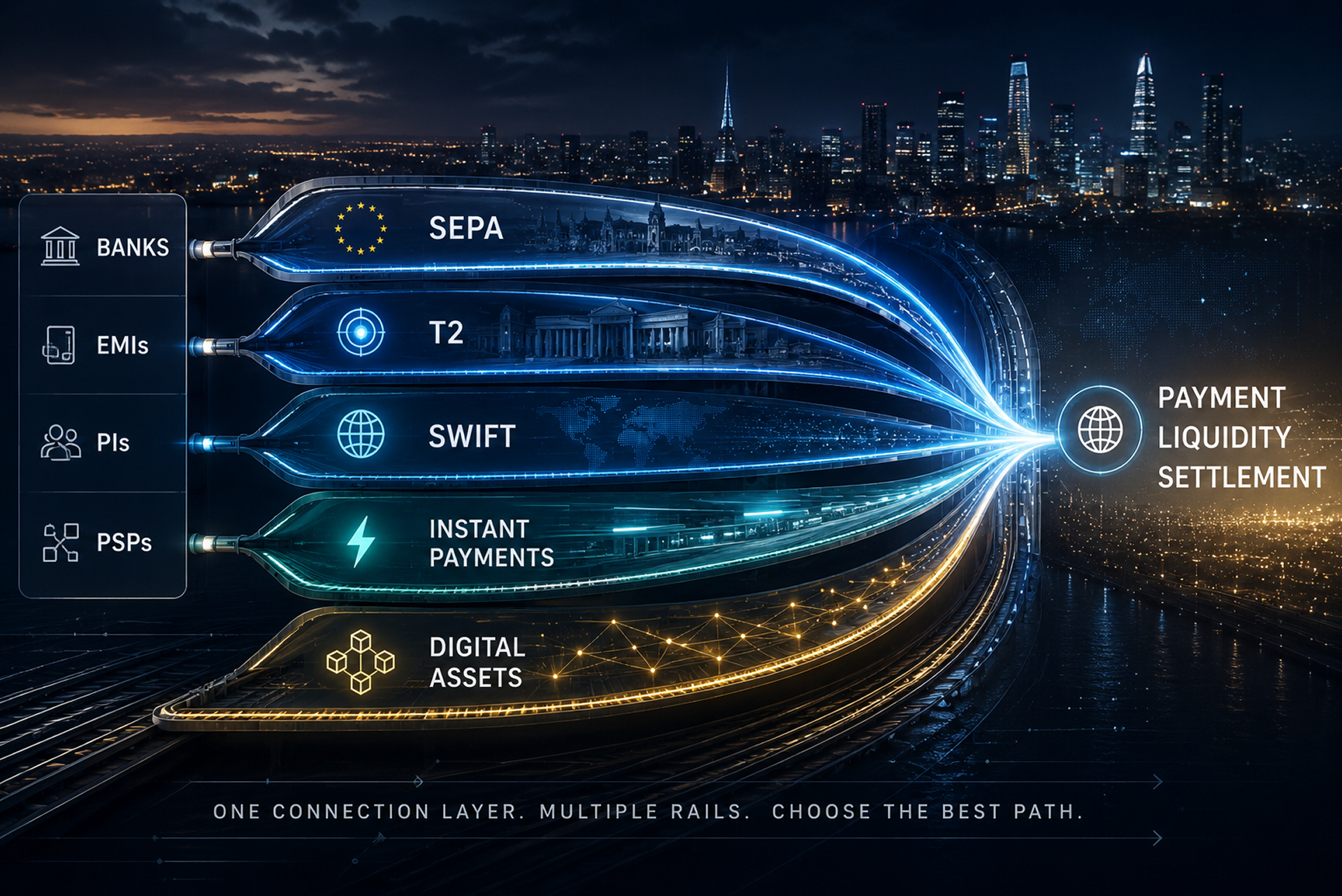
Banks, EMIs, PIs and PSPs need infrastructure that connects traditional money with digital-asset settlement safely, selectively and intelligently.
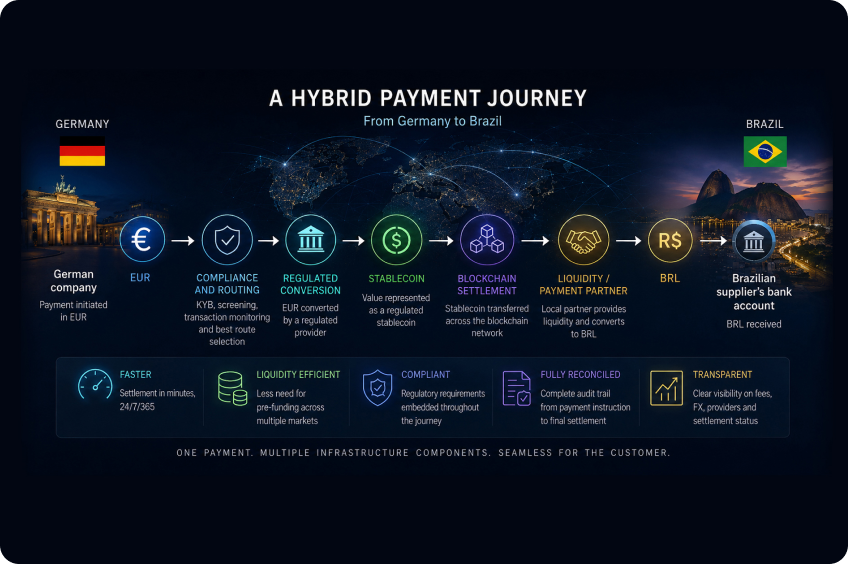
What does a stablecoin payment actually look like for a company that neither holds stablecoins nor wants to?

How payment infrastructure shapes working capital, liquidity, FX and financial performance.

How multi-rail payments are reshaping compliance architecture, transaction control and the role of the MLRO

How stablecoins are evolving from crypto instruments into mainstream infrastructure for payments, settlement and treasury.

Trade finance still depends on infrastructure designed for banking hours, correspondent networks and multi-day settlement. Stablecoins offer a new way to move value across borders, and the opportunity is not to replace the existing financial system but to connect it more efficiently.

For generations, colonial-era infrastructure and commercial links tied individual African countries to markets in Europe rather than to one another. As intra-African trade expands and new commercial corridors emerge, the continent needs payment infrastructure that is equally capable of crossing borders. Stablecoins could become an important part of that infrastructure.
Submit your email if you want to be updated on future articles about the New Infrastructure of Money and other valuable insights from Valuno.
Select a term to read its definition without leaving this page.
A stablecoin is a digital asset designed to maintain a stable value relative to a reference asset, most commonly a fiat currency such as the US dollar or euro. Stablecoins are issued and transferred using blockchain technology and can enable near-real-time, 24/7 movement of value without relying on traditional banking settlement for every transaction. Fiat-backed stablecoins, such as USDC and EURC, are typically supported by reserves held in cash and highly liquid financial assets. In payment infrastructure, stablecoins can function as an additional settlement rail, complementing bank transfers, instant payments and other established methods rather than replacing them. Their practical use depends on liquidity, redemption mechanisms, regulatory compliance and reliable connectivity between digital assets and conventional bank money.
A payment rail is the underlying network or infrastructure through which money or other forms of value move between parties. Payment rails define how transactions are transmitted, processed, cleared and/or settled. Examples include domestic clearing systems, SEPA, SWIFT-enabled correspondent banking, card networks, instant payment systems and blockchain networks used for digital-asset settlement. Different rails have different characteristics in terms of speed, cost, availability, geographic reach, currencies and settlement finality. In a multi-rail payment environment, the most appropriate rail can be selected according to the requirements of each transaction.
With Payment orchestration we mean the coordination and management of multiple payment components through a common infrastructure layer. It enables transactions to be routed between different payment rails, providers, assets, currencies and settlement methods according to factors such as cost, speed, availability, liquidity, compliance requirements and transaction characteristics. In a hybrid financial system, payment orchestration can connect traditional banking infrastructure with instant payments and digital-asset settlement, allowing the most appropriate route to be selected for each transaction.
With settlement we mean the actual discharge of a financial obligation through the transfer of money or another agreed asset between parties. It is distinct from a payment instruction: an instruction initiates or authorises a payment, while settlement occurs when the corresponding value has actually been transferred and the obligation is fulfilled. Settlement can form part of a payment flow between financial institutions, payment providers or their customers, but can also relate directly to an underlying commercial obligation, such as settling an invoice, supplier payment, securities transaction or other amount due. Depending on the payment rail and arrangement used, settlement may occur immediately, later in the day or after one or more clearing and intermediary stages.
Fiat money / fiat currency means money issued by a government or central bank and recognised as legal tender, whose value is not backed by a physical commodity such as gold. The term fiat comes from Latin, meaning approximately “let it be done” or “let it be made”, reflecting that the money has value by authoritative decree rather than because the currency itself represents a commodity of equivalent value. The term became particularly relevant as monetary systems moved away from gold and other commodity standards during the 19th and 20th centuries. Examples of modern fiat currencies include the euro (EUR), US dollar (USD), pound sterling (GBP) and Swedish krona (SEK). Fiat money exists both as physical cash and, predominantly, as electronic balances within the banking system. In modern payment flows, fiat currency can be converted into digital assets such as stablecoins and subsequently converted back into fiat, allowing traditional and blockchain-based settlement infrastructure to be combined.
On-ramp / Off-ramp means the mechanisms that connect traditional fiat money with digital assets. An on-ramp converts fiat currency, such as EUR or USD, into a digital asset such as a stablecoin, while an off-ramp converts the digital asset back into fiat currency. For example, a cross-border payment may involve EUR being on-ramped into USDC, transferred over a blockchain network, and subsequently off-ramped into the beneficiary’s local currency. On- and off-ramps typically involve regulated service providers, liquidity, foreign exchange, banking connections and compliance controls, making them important interfaces between traditional financial infrastructure and digital-asset settlement.
Correspondent banking is an arrangement in which one bank provides banking and payment services to another bank, typically to enable transactions in countries or currencies where the other bank does not have direct access to the local banking or clearing system. In a cross-border payment, the sending bank may therefore route funds through one or more correspondent or intermediary banks before they reach the beneficiary’s bank. Each institution may perform its own processing, compliance checks, currency conversion and reconciliation, potentially adding time, cost and operational complexity. Correspondent banking remains a fundamental part of the global financial system, particularly for international payments and currencies where direct clearing relationships are unavailable.
SWIFT (Society for Worldwide Interbank Financial Telecommunication) is a global financial messaging network that enables banks and other financial institutions to exchange standardised, secure instructions and information about financial transactions. Importantly, SWIFT does not normally move or hold the money itself. Rather, it provides the messages that instruct and coordinate payments, while the actual transfer and settlement of funds take place through correspondent banking relationships, accounts and payment systems.
SWIFT was founded in Belgium in 1973 by 239 banks from 15 countries as a cooperative initiative to replace slower and less standardised methods of international financial communication, particularly Telex. It became operational in 1977 and developed into the principal messaging infrastructure supporting international banking. In a cross-border payment, a SWIFT message may therefore travel between institutions while the underlying money moves separately through one or more correspondent banks before final settlement.
SEPA / SEPA Instant — The Single Euro Payments Area (SEPA) is a European framework that enables euro payments to be made across participating countries under harmonised rules and standards, making cross-border euro transfers function much like domestic payments. SEPA was developed as part of European financial integration following the introduction of the euro, with the first SEPA Credit Transfer scheme launched in 2008. It covers the EU as well as several non-EU European countries and territories.
SEPA Instant, formally the SEPA Instant Credit Transfer (SCT Inst) scheme, was introduced in 2017 to enable euro transfers to be processed within seconds, 24 hours a day, 365 days a year. The maximum transaction amount has increased substantially as the scheme has matured: the original limit of €15,000 was raised to €100,000 in 2020, and from 5 October 2025 the scheme-level maximum amount was removed altogether, allowing participants to support transactions of any size, subject to limits applied by individual banks and payment service providers. Unlike traditional cross-border correspondent banking, SEPA provides a highly standardised regional payment environment in which participating institutions can transfer euros efficiently through connected clearing and settlement infrastructure. SEPA and SEPA Instant therefore illustrate how common standards, direct connectivity and modern settlement infrastructure can significantly reduce the time and complexity involved in moving money across borders.
T2 is the Eurosystem’s real-time gross settlement (RTGS) system for settling large-value payments in central bank money. It replaced TARGET2 in March 2023 as part of the Eurosystem’s consolidation and modernisation of its payment infrastructure. T2 provides participating banks and other eligible institutions with accounts at their respective central banks and settles transactions individually, in real time and with immediate finality, rather than accumulating obligations for later net settlement. It is particularly important for large-value and time-critical euro payments and also provides the central liquidity management infrastructure supporting other Eurosystem services. T2 should not be confused with SEPA: SEPA defines schemes and standards for customer payments, while T2 operates at the underlying interbank settlement level, where obligations between financial institutions can ultimately be settled in central bank money.
Bank for International Settlements (BIS) is an international organisation that promotes cooperation among central banks and supports global monetary and financial stability. Often described as the “bank for central banks”, the BIS was established in 1930 and is headquartered in Basel, Switzerland, making it the world’s oldest international financial institution. It provides banking services to central banks and international organisations, conducts research on monetary and financial issues, and provides a forum in which central banks and regulators can cooperate on financial policy, payments and emerging technologies. The BIS also hosts important standard-setting bodies, including the Basel Committee on Banking Supervision (BCBS) and the Committee on Payments and Market Infrastructures (CPMI). In payments and digital assets, the BIS plays an influential role in research and policy development concerning cross-border payments, stablecoins, tokenisation, central bank digital currencies and the future architecture of the international monetary system.
RTGS (Real-Time Gross Settlement) is a payment settlement mechanism in which transfers between financial institutions are settled individually (“gross”) and continuously in real time, rather than being accumulated and netted against other transactions for settlement later. Once an RTGS payment has been settled, it is generally final and irrevocable. RTGS systems are primarily used for large-value, time-critical and interbank payments, where minimising settlement and counterparty risk is particularly important. Settlement typically takes place in central bank money, through accounts held by participating institutions at the central bank. Examples include the Eurosystem’s T2, the Federal Reserve’s Fedwire Funds Service in the United States and the Bank of England’s RTGS service supporting CHAPS. RTGS forms a critical underlying layer of modern payment infrastructure: customer-facing payment schemes may initiate, clear or aggregate transactions, while the resulting obligations between financial institutions can ultimately be settled through an RTGS system.
PSP (Payment Service Provider) is a company or financial institution that enables businesses and consumers to make, receive or process payments. Depending on its role and regulatory authorisation, a PSP may provide services such as payment initiation, card acquiring, bank transfers, merchant accounts, payment processing, currency conversion and access to different payment methods or payment rails. PSPs typically connect merchants and other customers with banks, card networks, clearing systems and other financial infrastructure, reducing the need for businesses to integrate separately with each provider. In a modern multi-rail environment, PSPs may also connect to instant payments and digital-asset infrastructure alongside conventional banking and card-based payment systems.
An EMI (Electronic Money Institution) is a regulated financial institution authorised to issue electronic money (e-money) and, depending on its authorisation, provide payment services such as payment accounts, transfers, card issuance, acquiring and foreign-exchange-related services. In the EU, EMIs have historically been regulated separately from Payment Institutions (PIs) under the Electronic Money Directive (EMD2). Unlike a bank, an EMI does not generally take deposits or lend customer funds on its own account; customer funds received in exchange for e-money must instead be safeguarded in accordance with regulatory requirements.
Under the forthcoming PSD3 and Payment Services Regulation (PSR) framework, the historically separate regulatory regimes for EMIs and PIs are being brought into a unified framework, with EMD2 intended to be repealed. This does not mean that electronic money itself disappears: specific requirements governing the issuance, safeguarding and redemption of e-money are retained. The EMI should therefore increasingly be understood as a specialised form of regulated payment service provider within a common EU payments framework, rather than as a wholly separate regulatory category.
A PI (Payment Institution) is a regulated financial institution authorised to provide one or more payment services, such as executing payment transfers, issuing payment instruments, merchant acquiring, money remittance or payment initiation services. In the EU, Payment Institutions have historically been regulated under the Payment Services Directive (PSD2). Unlike a bank, a PI generally does not take deposits or use customer funds to provide lending on its own account; funds received for the execution of payment transactions must instead be protected in accordance with regulatory safeguarding requirements.
PIs are an important part of the European payments ecosystem, providing businesses and consumers with access to payment accounts, transfers and other payment services without necessarily operating as banks. Under the forthcoming PSD3 and Payment Services Regulation (PSR) framework, the historically separate regulatory regimes for Payment Institutions and Electronic Money Institutions (EMIs) are being brought into a more unified framework. This is intended to create a more consistent regulatory structure for non-bank payment service providers while retaining specific requirements for activities such as the issuance of electronic money.
A Bank is a regulated financial institution authorised to accept deposits from customers and use those funds, within regulatory limits, to provide credit and conduct other banking activities. In the EU, banks are generally authorised as credit institutions and are subject to extensive prudential requirements covering capital, liquidity, governance and risk management. Customer deposits may also be protected by statutory deposit-guarantee schemes, subject to applicable limits and conditions.
The ability to accept deposits from the public and use those funds for lending on the bank’s own balance sheet is a fundamental distinction between a bank and non-bank payment institutions such as Payment Institutions (PIs) and Electronic Money Institutions (EMIs). PIs and EMIs can hold safeguarded customer funds and provide a wide range of payment services, but they cannot generally accept deposits or use safeguarded customer money to finance lending in the way a bank can. Banks can therefore perform maturity transformation and credit creation, using deposits and other funding to provide loans while maintaining the liquidity and capital required by banking regulation. Banks may also have direct access, subject to applicable rules, to central-bank facilities and settlement infrastructure that is not available to all non-bank payment providers.
Banks can additionally provide payment accounts, transfers, cards, foreign exchange, trade finance, guarantees, lending, securities services and other financial products depending on their authorisation. They play a central role in payment infrastructure because they hold customer deposits, provide credit and liquidity, maintain accounts with other banks and central banks, and participate directly or indirectly in clearing and settlement systems. In an increasingly multi-rail financial system, banks can connect traditional deposit money and central-bank settlement infrastructure with instant payments and, where permitted, digital-asset services.
FX (Foreign Exchange) means the conversion of one currency into another, for example euros (EUR) into US dollars (USD). Foreign exchange is a fundamental component of international payments because the currency held by the payer may differ from the currency required by the beneficiary or by an intermediate settlement rail. FX can take place through banks, payment providers, specialist liquidity providers, exchanges and other financial institutions.
The exchange rate is the price of one currency expressed in another currency — for example, how many US dollars one euro buys. The FX spread is the difference between the rates at which a provider buys and sells a currency, or, from the customer’s perspective, the difference between the underlying market rate and the rate actually offered for the transaction. The spread therefore represents an important part of the effective cost of currency conversion and may be less visible than an explicit transaction fee.
In a cross-border or multi-rail payment, FX may occur at one or several stages. For example, EUR may be converted into USD or a USD-denominated stablecoin for settlement and subsequently converted into the beneficiary’s local fiat currency. Efficient payment orchestration therefore considers not only the payment rail and transaction fee, but also where FX takes place, which provider performs it, available liquidity and the total FX spread, as these factors can materially affect the final cost of the payment.
Reconciliation means the process of matching and verifying the different records associated with a financial transaction to ensure that the expected and actual movements of value correspond. In a payment flow, this may involve linking the original payment instruction or invoice with the amount sent, FX conversion, fees, settlement transaction, amount received by the beneficiary and the corresponding accounting entries.
Reconciliation becomes more complex when a transaction passes through several banks, payment providers, currencies or settlement rails, as each participant may generate separate transaction references, timestamps and records. In hybrid payment flows, reconciliation may also need to connect fiat transactions with blockchain transactions and wallet records. Effective reconciliation provides a complete audit trail from the underlying commercial obligation through payment and settlement to the final accounting record, helping organisations identify discrepancies, failed or incomplete payments, unexpected fees and differences in FX rates.
KYB (Know Your Business) is the process by which a financial institution or other regulated service provider identifies and verifies a corporate customer and assesses the risks associated with doing business with it. KYB is the business equivalent of KYC (Know Your Customer) and forms an important part of anti-money laundering (AML), counter-terrorist financing and sanctions compliance.
KYB typically involves verifying the company’s legal existence, registration details, ownership and control structure, directors, business activities and operating locations, as well as identifying and verifying its ultimate beneficial owners (UBOs). Depending on the risk profile, it may also include understanding the expected nature and volume of transactions, source of funds or wealth, counterparties and geographic exposure, and screening the company and relevant individuals against sanctions, PEP and adverse-media databases.
KYB is not normally a one-time exercise. Regulated institutions are expected to maintain appropriate ongoing due diligence, updating customer information and monitoring activity to determine whether transactions remain consistent with the customer’s known business and risk profile.
KYC (Know Your Customer) is the process by which a financial institution or other regulated service provider identifies and verifies an individual customer and assesses the risks associated with providing services to that person. KYC is a core component of anti-money laundering (AML), counter-terrorist financing and sanctions compliance, and is the individual-customer counterpart to KYB (Know Your Business) for corporate customers.
KYC typically involves collecting and verifying information such as the customer’s full name, date of birth, residential address and identity documents. Depending on the customer, product and risk profile, additional due diligence may include establishing the source of funds and source of wealth, understanding the purpose and expected use of the account or service, and screening against sanctions, politically exposed person (PEP) and adverse-media databases.
KYC is not simply an onboarding check. Regulated institutions are generally required to maintain appropriate ongoing customer due diligence and transaction monitoring, updating information when necessary and investigating activity that is inconsistent with the customer’s expected profile. Higher-risk customers or circumstances may require enhanced due diligence (EDD) and additional verification.
AML (Anti-Money Laundering) means the laws, regulations, controls and procedures designed to prevent criminals from disguising the origin of illegally obtained funds and integrating them into the legitimate financial system. Money laundering is commonly described as involving three stages: placement, where illicit funds enter the financial system; layering, where transactions are used to obscure their origin and ownership; and integration, where the funds re-enter the legitimate economy appearing to have a lawful source.
Financial institutions and other regulated businesses are required to maintain AML frameworks proportionate to their activities and risks. These typically include KYC and KYB, customer risk assessment, sanctions and PEP screening, transaction monitoring, source-of-funds and source-of-wealth checks, record keeping, ongoing due diligence and reporting of suspicious activity to the relevant authorities.
In modern payment and digital-asset infrastructure, AML controls may need to operate across bank accounts, payment providers, currencies, wallets and blockchain networks. This can include blockchain analytics and wallet screening alongside conventional transaction monitoring. Effective AML therefore depends not only on identifying customers at onboarding, but also on understanding the parties, purpose and flow of funds throughout the financial relationship.
Travel Rule is a regulatory requirement designed to ensure that identifying information about the originator and beneficiary travels with certain transfers of funds or crypto-assets between regulated financial institutions. Its purpose is to improve traceability and help prevent money laundering, terrorist financing and other illicit use of the financial system.
The concept originated in traditional banking and was extended to virtual assets through recommendations from the Financial Action Task Force (FATF). In the EU, the Transfer of Funds Regulation (TFR) extends Travel Rule requirements to crypto-asset transfers involving regulated crypto-asset service providers. Depending on the transaction and applicable rules, information such as names, account or wallet details and other identifying data may have to be collected, verified and transmitted between the institutions involved.
The Travel Rule does not mean that personal information is written onto a public blockchain. The required information is generally exchanged separately and securely between regulated service providers, while the crypto-asset itself moves over the blockchain. In a hybrid payment flow, Travel Rule compliance therefore forms part of the compliance layer connecting customers, regulated intermediaries and digital-asset settlement infrastructure.
Source of Funds (SoF) means the origin of the specific money or other assets being used in a particular transaction or business relationship. The purpose of a Source of Funds check is to establish where the funds came from and whether that origin is legitimate and consistent with what is known about the customer.
For an individual, the source might be salary, savings, investment proceeds, the sale of property, an inheritance or a loan. For a business, it could include operating revenue, investment capital, financing, proceeds from an asset sale or funds received from customers. Evidence may include bank statements, payslips, contracts, invoices, audited accounts, loan agreements or transaction records.
Source of Funds is distinct from Source of Wealth (SoW). SoF concerns the origin of the money involved in a specific transaction or relationship, whereas SoW concerns how the customer accumulated their overall wealth over time. In payment and digital-asset transactions, SoF checks form part of the broader AML and customer due-diligence framework and may become particularly important for unusually large, complex or higher-risk transactions.
IBAN (International Bank Account Number) is a standardised international format for identifying bank and payment accounts, designed to make domestic and cross-border payments more reliable and reduce errors in account identification. The IBAN was originally developed in Europe and is defined under the international ISO 13616 standard. It is widely used across Europe and in many other countries, although it is not universal; for example, the United States does not use IBANs for domestic accounts.
An IBAN begins with a two-letter country code, followed by two check digits and a country-specific sequence identifying the relevant bank and account. Its length varies by country, up to a maximum of 34 alphanumeric characters. For example, a Swedish IBAN begins with SE, while a French IBAN begins with FR.
An IBAN identifies the account to which a payment should be routed; it is not itself a payment rail or payment method. Payments addressed using an IBAN may travel through infrastructure such as SEPA, SEPA Instant or correspondent banking, depending on the currencies, institutions and transaction involved. The IBAN therefore provides standardised account identification while the underlying payment and settlement systems perform the actual movement of funds.
BIC (Business Identifier Code) is an internationally standardised code used to identify banks and other financial institutions in financial messaging and payment transactions. BICs are defined by the ISO 9362 standard and are assigned and managed by SWIFT, which is why a BIC is commonly referred to as a SWIFT code or SWIFT/BIC.
A BIC normally consists of 8 or 11 characters identifying the institution, country, location and, where applicable, a specific branch. Unlike an IBAN, which identifies a particular customer account, the BIC identifies the financial institution involved in the transaction.
BICs are widely used in international payments and SWIFT messaging to ensure that payment instructions and other financial messages are routed to the correct institution. Within SEPA, the payer often needs to provide only the beneficiary’s IBAN because the necessary BIC can be derived or handled automatically by the payment infrastructure. For other international payments, particularly those involving correspondent banking, the BIC remains an important identifier for the banks and intermediaries participating in the payment flow.
Blockchain settlement is the transfer of a digital asset between parties through a blockchain network in order to discharge or facilitate a financial obligation. Instead of updating balances across a chain of correspondent banks or other centralised intermediaries, the transaction is recorded on a distributed ledger and validated according to the rules of the relevant blockchain. Depending on the network, transactions can be processed continuously, 24 hours a day, seven days a week, and may reach practical finality within seconds or minutes.
In payments, blockchain settlement can involve assets such as stablecoins, allowing value denominated in a familiar currency such as the US dollar or euro to be transferred over blockchain infrastructure. For example, EUR may be converted into USDC through an on-ramp, USDC transferred to another wallet over a blockchain, and subsequently converted through an off-ramp into the beneficiary’s required fiat currency.
Blockchain settlement should not, however, be confused with the complete payment process. The blockchain may settle the digital-asset leg quickly, while the overall transaction can still depend on banking connections, FX, liquidity, compliance, on- and off-ramps and reconciliation. Its principal significance is therefore as an additional settlement rail that can be integrated with traditional financial infrastructure, rather than as a replacement for every component of the payment system.
Smart contract / Programmable settlement means that software deployed on a blockchain that can automatically execute predefined actions when specified conditions are met. It can, for example, transfer digital assets, release funds or interact with other blockchain-based applications according to rules encoded in the software. Despite the name, a smart contract is not necessarily a legal contract; it is primarily an automated execution mechanism.
Programmable settlement is a broader concept. It refers to the ability to make the execution, routing, timing or conditions of settlement respond automatically to predefined rules, data or events. This may involve smart contracts, but it can also be implemented through payment orchestration, APIs and conventional financial infrastructure. Examples include releasing payment when an invoice is approved, selecting a settlement rail according to cost or liquidity, automatically converting currencies or assets, or executing settlement only when specified compliance conditions have been satisfied.
Programmable settlement should therefore not be understood simply as “putting payments on a blockchain”. Its significance lies in connecting business rules and transaction conditions directly with the execution of settlement, potentially across both traditional and digital payment rails.
Tokenisation is the process of representing an asset, right or claim as a digital token that can be recorded, transferred and potentially settled using distributed-ledger or blockchain infrastructure. The underlying asset may be financial, such as money, bonds, shares or fund units, or a real-world asset such as property or commodities. The token represents defined rights or claims associated with that underlying asset rather than necessarily being the asset itself.
Tokenisation can make assets easier to transfer, divide, automate and integrate with digital financial infrastructure. It can also allow ownership records, transaction logic and settlement to operate on closely connected systems, potentially reducing some of the reconciliation and intermediary processes found in conventional financial markets.
Stablecoins are one form of tokenised value, typically representing a claim or value linked to a fiat currency. The broader development of tokenised deposits, securities and other financial assets could therefore extend blockchain-based infrastructure well beyond today's stablecoin payments. Tokenisation does not, however, remove the need for legal ownership structures, regulation, custody, compliance or reliable links to the underlying asset. Its importance lies in creating digitally transferable representations of value that can interact with increasingly programmable and multi-rail financial infrastructure.
Custody / Digital-asset custody means the safekeeping and administration of financial assets on behalf of a customer. In traditional finance, custody may involve holding securities or other assets and maintaining the records and controls necessary to protect the customer’s ownership interests. Digital-asset custody applies these principles to crypto-assets such as stablecoins and other blockchain-based tokens.
Because control of a digital asset is generally exercised through cryptographic private keys, digital-asset custody is fundamentally concerned with securing those keys and controlling how they can be used. Custody solutions may employ secure key-management technology, segregated wallets, multi-signature arrangements, approval workflows, access controls and detailed audit trails to reduce the risk of theft, loss or unauthorised transactions.
Custody is distinct from simply transferring or exchanging a digital asset. A payment provider may facilitate a stablecoin transaction without taking custody if it never controls the customer’s assets or the private keys necessary to move them. This distinction is particularly important from a regulatory perspective, as providing custody of crypto-assets on behalf of clients is generally a specifically regulated activity. In a multi-rail payment infrastructure, custody arrangements therefore help determine who controls the asset at each stage of the transaction and who has authority to move it.
USDC (USD Coin) is a US dollar-denominated stablecoin issued by Circle and designed to maintain a value of approximately one USDC to one US dollar. It was launched in 2018 and has become one of the largest and most widely used stablecoins for payments, trading, treasury management and blockchain-based settlement.
USDC is backed by highly liquid reserve assets and is designed to be redeemable for US dollars at par through the appropriate regulated channels. Unlike cryptocurrencies such as Bitcoin, whose market value can fluctuate substantially, USDC is intended to provide a relatively stable digital representation of US-dollar value that can be transferred across supported blockchain networks.
In payment infrastructure, USDC can function as a settlement asset and rail component. For example, EUR can be converted into USDC through an on-ramp, USDC can then be transferred 24/7 over a blockchain network, and the recipient can retain it or convert it through an off-ramp into another fiat currency. The complete payment still depends on factors such as liquidity, FX, compliance, custody, blockchain network availability and access to reliable on- and off-ramps.
In the European Economic Area, USDC is offered within the regulatory framework established by the EU’s Markets in Crypto-Assets Regulation (MiCA). USDC should therefore be understood not simply as a cryptocurrency, but increasingly as a regulated digital settlement asset connecting fiat money with blockchain-based financial infrastructure.
USDT (Tether) is a US dollar-denominated stablecoin issued by Tether and designed to maintain a value of approximately one USDT to one US dollar. Launched in 2014, it was one of the earliest widely adopted stablecoins and has become the largest by circulation, with particularly extensive use in crypto trading, international transfers, emerging markets and markets where access to US dollars through conventional banking channels may be limited.
USDT is backed by reserves maintained by Tether, including cash, short-term US government securities and other reserve assets. Its purpose is to combine the relative price stability of the US dollar with the ability to transfer digital assets across supported blockchain networks, 24 hours a day, seven days a week. USDT is issued on several blockchains, including Ethereum and Tron, making the choice of network an important part of any transfer.
In payment infrastructure, USDT can be used as a digital settlement asset, allowing fiat currency to be on-ramped into USDT, transferred over a blockchain and subsequently off-ramped into another fiat currency. As with USDC, the blockchain transfer represents only one part of the complete payment flow, which may also involve banking, FX, liquidity, compliance, custody and reconciliation.
USDT differs importantly from USDC in its European regulatory position. Tether has not obtained authorisation for USDT as a MiCA-compliant e-money token in the European Economic Area. Consequently, regulated European crypto-asset service providers face restrictions on offering or promoting USDT, and several major platforms have delisted or restricted it for EEA customers. USDT nevertheless remains highly significant globally because of its scale, liquidity and widespread use in digital-asset markets and cross-border value transfer.
EURC (Euro Coin) is a euro-denominated stablecoin issued by Circle and designed to maintain a value of one EURC to one euro. Originally launched in 2022 as Euro Coin, it was renamed EURC in 2023 and is the euro counterpart to Circle’s US dollar-denominated USDC. EURC is backed by euro-denominated reserves and is designed to be redeemable at par through the appropriate regulated channels.
EURC enables euro-denominated value to be transferred over supported blockchain networks 24 hours a day, seven days a week, without requiring every stage of the transaction to pass through conventional banking settlement. It can therefore be used for payments, treasury management, liquidity movement and blockchain-based settlement while allowing the underlying value to remain denominated in euros.
EURC is particularly relevant in Europe because Circle issues it as a MiCA-compliant e-money token (EMT) through its regulated European entity. This connects EURC directly with the developing EU regulatory framework for digital money and distinguishes it from stablecoins that are not authorised for issuance under MiCA.
In a hybrid payment flow, EURC can complement infrastructure such as SEPA and SEPA Instant rather than necessarily compete with it. Fiat euros can be converted into EURC through an on-ramp, transferred over a blockchain and subsequently converted back into euros or another currency through an off-ramp. EURC therefore illustrates how euro-denominated bank money and blockchain-based settlement can form different, interconnected rails within the same financial system.
MiCA (Markets in Crypto-Assets Regulation) is the European Union’s regulatory framework for crypto-assets and the businesses providing crypto-asset services. Formally Regulation (EU) 2023/1114, MiCA was adopted in 2023, with its stablecoin provisions applying from 30 June 2024 and the broader regime for crypto-asset service providers applying from 30 December 2024. It establishes a common regulatory framework across the EU, replacing much of the previously fragmented national approach to crypto-asset regulation.
MiCA regulates both the issuance of certain crypto-assets and the activities of Crypto-Asset Service Providers (CASPs). Regulated services include custody and administration of crypto-assets, operating trading platforms, exchanging crypto-assets for funds or other crypto-assets, executing and transmitting orders, placing crypto-assets, providing transfer services and certain advisory and portfolio-management activities. Authorised CASPs are subject to requirements concerning governance, capital, safeguarding, conflicts of interest, customer protection and regulatory supervision.
MiCA also creates specific categories for stablecoins. An E-Money Token (EMT) seeks to maintain a stable value by referencing a single official currency, while an Asset-Referenced Token (ART) references other assets, rights or combinations of assets. This distinction is particularly important for euro- and dollar-denominated stablecoins used within Europe.
A central objective of MiCA is to allow authorised businesses to operate under a more harmonised European framework, including the ability to passport authorised crypto-asset services across EU Member States. For payments and settlement infrastructure, MiCA is particularly significant because it brings activities such as stablecoin issuance, crypto-asset custody, exchange and transfer into a defined regulatory structure, helping connect digital-asset infrastructure with the established European financial system.
The GENIUS Act (Guiding and Establishing National Innovation for U.S. Stablecoins Act) is the United States’ federal regulatory framework for payment stablecoins. It establishes rules governing who may issue payment stablecoins in the US and introduces requirements concerning reserves, redemption, disclosure, risk management, supervision, anti-money-laundering and sanctions compliance. Payment stablecoins must generally be backed 1:1 by permitted reserve assets, such as cash, insured bank deposits and short-term US Treasury securities.
The GENIUS Act is sometimes compared with the EU’s MiCA framework, but the two are not direct equivalents. MiCA regulates a much broader range of crypto-assets and crypto-asset services, whereas the GENIUS Act is specifically focused on payment stablecoins and their issuers. For international payment infrastructure, it is significant because it provides greater regulatory certainty for the use of regulated stablecoins as instruments for payment and settlement in the US.
CASP (Crypto-Asset Service Provider) is a company authorised under the EU’s Markets in Crypto-Assets Regulation (MiCA) to provide one or more regulated crypto-asset services to clients. CASPs form the principal regulated intermediary category for crypto-assets in the European Union, broadly performing functions for digital assets that banks, investment firms and payment institutions perform in their respective areas of traditional finance.
MiCA defines a range of regulated crypto-asset services, including custody and administration of crypto-assets, operating a crypto-asset trading platform, exchanging crypto-assets for funds, exchanging one crypto-asset for another, executing or transmitting client orders, placing crypto-assets, providing crypto-asset transfer services, advice and portfolio management. A CASP does not automatically have permission to perform all of these activities; its authorisation specifies which services it may provide.
CASPs are subject to regulatory requirements concerning governance, capital, safeguarding of client assets, conflicts of interest, complaints handling, operational resilience, AML and customer protection. Once authorised in one EU Member State, a CASP can generally passport its authorised services across the EU, subject to the MiCA notification framework.
A CASP authorisation should not be confused with a banking, Payment Institution (PI) or Electronic Money Institution (EMI) licence. A CASP may provide authorised crypto-asset services but does not, solely by virtue of being a CASP, have the right to accept bank deposits, issue electronic money or provide all regulated fiat payment services. Hybrid payment models may therefore involve CASPs working alongside banks, PIs and EMIs to connect fiat money with digital-asset settlement.
VASP (Virtual Asset Service Provider) was the term commonly used in the EU before MiCA for businesses providing services involving virtual assets, such as exchanging crypto-assets for fiat currency, exchanging crypto-assets for other crypto-assets, transferring crypto-assets or providing custody services.
Before MiCA, crypto-asset businesses in the EU were primarily regulated through national registration and anti-money laundering (AML) regimes derived from EU AML legislation. Requirements therefore differed between Member States, and a VASP registration was generally not equivalent to a full financial-services licence. It typically focused on AML and counter-terrorist financing controls and did not provide an EU-wide passport.
With the introduction of the Markets in Crypto-Assets Regulation (MiCA), the EU is replacing these fragmented national VASP arrangements with the harmonised Crypto-Asset Service Provider (CASP) framework. Existing VASPs may operate during applicable national transitional periods, but ultimately businesses providing regulated crypto-asset services in the EU must operate under the MiCA framework.
In an EU regulatory context, VASP therefore principally describes the pre-MiCA generation of nationally registered crypto-asset service providers, while CASP describes the new MiCA-authorised model.
Clearing is the process of determining and confirming the obligations between parties before settlement takes place. It can include validating and matching transactions and calculating the amounts to be transferred. In simple terms, clearing determines what the parties owe; settlement transfers the value and completes the transaction.
Liquidity is the availability of funds or assets needed to meet payment and settlement obligations when they fall due. Liquidity management is the process of ensuring that sufficient funds are available in the right currency, location and form at the right time. In a multi-rail payment environment, efficient liquidity management can reduce the need for pre-funding, release trapped capital and improve the use of working capital.
Pre-funding means the practice of placing funds in advance with banks, correspondent banks, payment providers or liquidity partners so that payments can be executed when required. In cross-border payments, this may require maintaining balances in multiple countries and currencies. Pre-funding can tie up capital, create funding costs and leave liquidity trapped across different accounts and markets.
A Liquidity Provider (LP) is a financial institution or other provider that supplies access to fiat or digital-asset liquidity, enabling currencies and assets to be converted and payments to be settled efficiently. In cross-border payments, liquidity providers help ensure that the required funds are available in the right currency, market and form when needed.
DLT / Distributed Ledger Technology is a technology for recording and sharing transactions across multiple participants or systems using a synchronised digital ledger rather than a single central database. Blockchain is a type of DLT, but not all distributed ledgers use blockchain architecture. DLT can support payments, settlement, tokenisation and other applications where participants need a shared and verifiable record of transactions.
API / Application Programming Interface means a standardised way for different software systems to communicate and exchange data or instructions. In payment infrastructure, APIs enable platforms to connect with banks, payment providers, liquidity providers, wallets and other services, allowing transactions and information to move between different systems.
A Ledger is a record of financial transactions and balances. Ledgers can exist within a company's payment platform, a bank's accounting system or on a distributed ledger such as a blockchain. In hybrid payment infrastructure, different ledgers may need to be connected and reconciled to maintain an accurate and consistent record of transactions and settlement.
A blockchain is a distributed digital ledger that records transactions across a network of connected participants rather than in a single central database. Transactions are grouped into blocks, cryptographically linked and validated according to the rules of the network, creating a shared record that is difficult to alter retrospectively.
Blockchain networks can be public and permissionless or private and permissioned. Public networks allow independent participants to validate and inspect transactions, while private networks restrict participation to approved entities. The appropriate model depends on the required level of openness, governance, privacy and control.
Cryptocurrencies, stablecoins and tokenised assets can use blockchain infrastructure to transfer value between digital wallets. The blockchain records and settles the digital-asset leg, while a complete payment may still depend on liquidity, foreign exchange, compliance, custody and connections to traditional banking infrastructure.
A digital-asset wallet is a tool for managing the cryptographic keys used to access and transfer assets recorded on a blockchain. A public address can be shared to receive assets, while the corresponding private key authorises transactions and must be protected from loss or unauthorised access.
In a custodial wallet, a third-party provider controls the private keys on the user’s behalf. In a non-custodial wallet, the user controls the keys directly and is responsible for securing and recovering them. The choice affects control, operational responsibility, security and the regulatory role of the provider.
Wallets can take several forms. Software wallets run on a computer or mobile device, web wallets are accessed through a browser, and hardware wallets keep private keys on a dedicated physical device that can remain offline when not in use.
Web3 is a broad term for internet services built around blockchain networks, digital assets and decentralised protocols. Its central idea is that users and builders can hold assets, identities or governance rights directly instead of relying entirely on a central platform to control them.
Web3 applications commonly use wallets to identify users and smart contracts to execute rules. Fungible tokens can represent transferable value or participation rights, while non-fungible tokens can represent ownership of unique digital items, credentials or other rights.
The degree of decentralisation varies widely between Web3 services. A service may use a decentralised settlement layer while still depending on centralised interfaces, infrastructure or governance. Web3 should therefore be understood as a spectrum of technical and organisational models rather than a single technology.