
Stablecoins have introduced a new way to move value globally. They can transfer funds across blockchain networks quickly, operate around the clock and reduce some of the friction associated with traditional correspondent banking. But for a CFO or head of treasury, moving a stablecoin from one wallet to another is rarely the real problem. The real challenge is how to connect that transaction to the rest of the financial system.
A corporate payment may begin with euros in a bank account, use a stablecoin for part of the settlement and end with ringgit, dollars, pounds or another currency in the beneficiary’s bank account. Along the way, the transaction may involve banks, payment institutions, liquidity providers, blockchain networks and compliance processes. Foreign exchange still has to take place, liquidity has to be available, and when the money has arrived, the transaction still needs to be recorded, reconciled and reported.
This is why stablecoins solve only part of the cross-border payment problem. A blockchain can provide fast transfer and settlement of a digital asset, and a wallet can hold that asset and initiate a transaction. Neither, by itself, provides the complete infrastructure a corporate treasury function needs.
For the CFO, the relevant question is therefore not simply: Can we move money on-chain? It is: Can we move money from where we hold it to where our supplier needs it, at the right cost and speed, with control over liquidity, compliance and reconciliation? This is where the missing layer between stablecoins and bank money becomes important.
Consider a Swedish manufacturing company that regularly buys components from a supplier in Malaysia. The Swedish company manages much of its liquidity in euros, while the Malaysian supplier invoices in Malaysian ringgit and wants MYR paid into its normal Malaysian bank account. Malaysian rules allow non-residents to make ringgit payments to Malaysian residents for settlement of trade in goods, subject to the applicable foreign-exchange rules and supporting documentation. (FMIP)
Traditionally, the manufacturer might instruct its bank to make the international payment over SWIFT. The payment and FX conversion would be handled through the banking chain until MYR reaches the supplier after around four days. What matters to the treasury department is the overall outcome: how many euros will the invoice cost, when will the supplier receive the money, what fees and FX spread will be incurred, how much liquidity needs to be positioned in advance, and when can the transaction finally be considered settled?
Now consider a hybrid route. The manufacturer initiates the payment in EUR. Subject to the available providers, regulatory requirements and economics of the transaction, the euros could be converted through an appropriate regulated provider into a stablecoin such as USDC. The stablecoin provides the international settlement leg and is transferred to a liquidity or payment partner capable of converting the value into MYR and completing the local payout to the supplier’s Malaysian bank account.
The payment journey could therefore look like this:
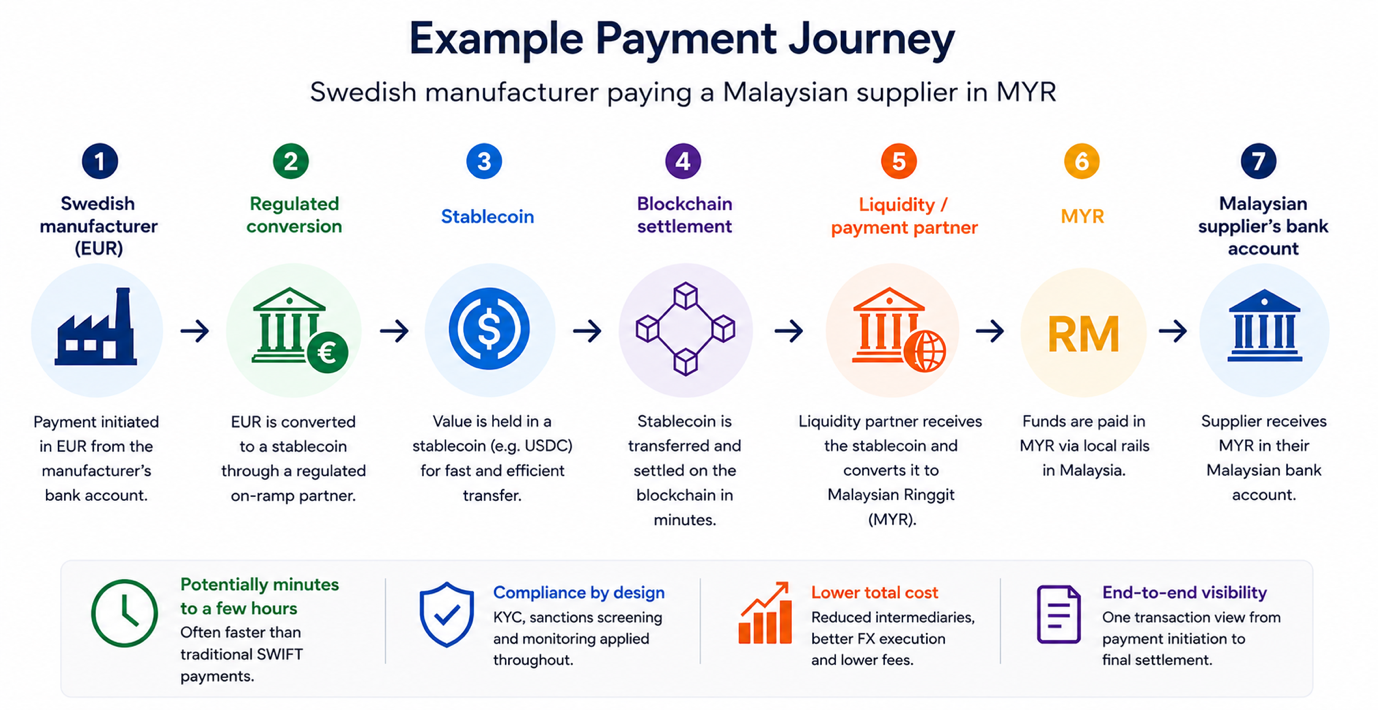
The supplier does not need a crypto-currency wallet, does not need to hold stablecoins and does not need to change the way it invoices its Swedish customer. It sends an invoice in MYR and receives MYR. The stablecoin is simply an intermediate settlement asset used within the payment infrastructure.
This example also illustrates why the blockchain itself is not the complete solution. Someone still needs to determine the appropriate route, select the providers, handle the conversion between fiat and digital assets, provide liquidity, perform the required compliance controls and make the final local payment. Malaysia, for example, has specific rules governing ringgit payments and FX transactions, while providing mechanisms for non-residents to access MYR through licensed onshore banks and their appointed overseas offices.
For the Swedish company’s treasury team, however, these should not feel like six or seven separate transactions. They should form one payment journey. That is what orchestration is about.
An orchestration layer connects the different components and can determine how they should work together. One payment may be best handled entirely through traditional banking infrastructure. Another may benefit from stablecoin settlement. A third may combine bank money at the beginning and end with blockchain-based settlement in the middle.
The objective is not to put every payment on a blockchain. It is to use the most appropriate infrastructure for each transaction.
That distinction matters because the fastest route is not necessarily the best route. A head of treasury may care about speed, but also about FX execution, liquidity, counterparty exposure, settlement certainty, regulatory requirements and total cost. The optimal route can therefore differ by currency, destination, amount and beneficiary.
Foreign exchange is particularly important. Stablecoins do not make FX disappear. In our Swedish-Malaysian example, EUR still has to become MYR. What changes is where and how the conversions take place. The blockchain may make the international settlement leg faster and continuously available, but the total economics of the payment still depend heavily on liquidity and FX execution.
For the CFO, the relevant comparison is therefore not simply bank transfer versus stablecoin. It is the total cost and efficiency of getting from EUR in Sweden to MYR in the supplier’s Malaysian bank account.
The same applies to liquidity. Traditional cross-border payments can require companies and financial institutions to maintain liquidity across different accounts, currencies and jurisdictions. Alternative settlement rails may reduce some of this requirement, but only if treasury can move efficiently between bank money, digital assets and local settlement. A stablecoin sitting in a wallet is not automatically useful liquidity. It becomes useful when it can be converted and deployed where the company needs it.
Then there is the less visible issue of reconciliation. A blockchain can show that a digital asset moved between two addresses, but that is not enough for corporate finance. The CFO needs to connect that movement to the original invoice and payment instruction, the counterparty, FX rate, providers, fees and final MYR payment. Treasury needs to know where the payment is. Accounting needs to reconcile it. Audit needs to be able to reconstruct what happened.
Without a common transaction record, some of the efficiency gained through faster settlement simply reappears as complexity in the back office.
Compliance presents the same challenge. Moving value over a blockchain does not remove requirements around KYB, sanctions, wallet screening, transaction monitoring, source of funds or internal approval policies. These controls need to follow the transaction across traditional and digital infrastructure. Compliance therefore has to become part of the payment flow, rather than something added afterwards.
This is the infrastructure gap that Valuno Atlas is designed to address. Atlas combines stablecoin conversion and orchestration with settlement services delivered through licensed payment partners. It is designed not simply as a wallet or blockchain interface, but as a transaction layer connecting traditional payment infrastructure with digital-asset settlement.
The principle is straightforward: do not replace the financial system; connect its different forms of money and settlement infrastructure more intelligently.
For CFOs and heads of treasury, that is ultimately the more interesting development. Most companies will continue to live in both worlds. They will hold money in bank accounts, receive revenues and pay suppliers in fiat currencies, while potentially using stablecoins where they provide a more efficient settlement route.
The future is therefore unlikely to be a choice between bank money and stablecoins. It is more likely to be a hybrid, multi-rail financial system in which bank transfers, instant payments and blockchain-based settlement coexist.
In that environment, the strategic question is not whether a company should “use crypto”. It is whether treasury can choose the best available route for moving value while retaining the control, compliance, visibility and reconciliation expected of a corporate payment.
The missing layer is the infrastructure that makes all of this work as one transaction – connecting bank money, stablecoins, FX, liquidity, compliance and local settlement from the payer’s account to the beneficiary’s account.