


Controlled infrastructure
Use stablecoins for settlement without building or operating the underlying infrastructure.

Use case · Valuno ATLAS
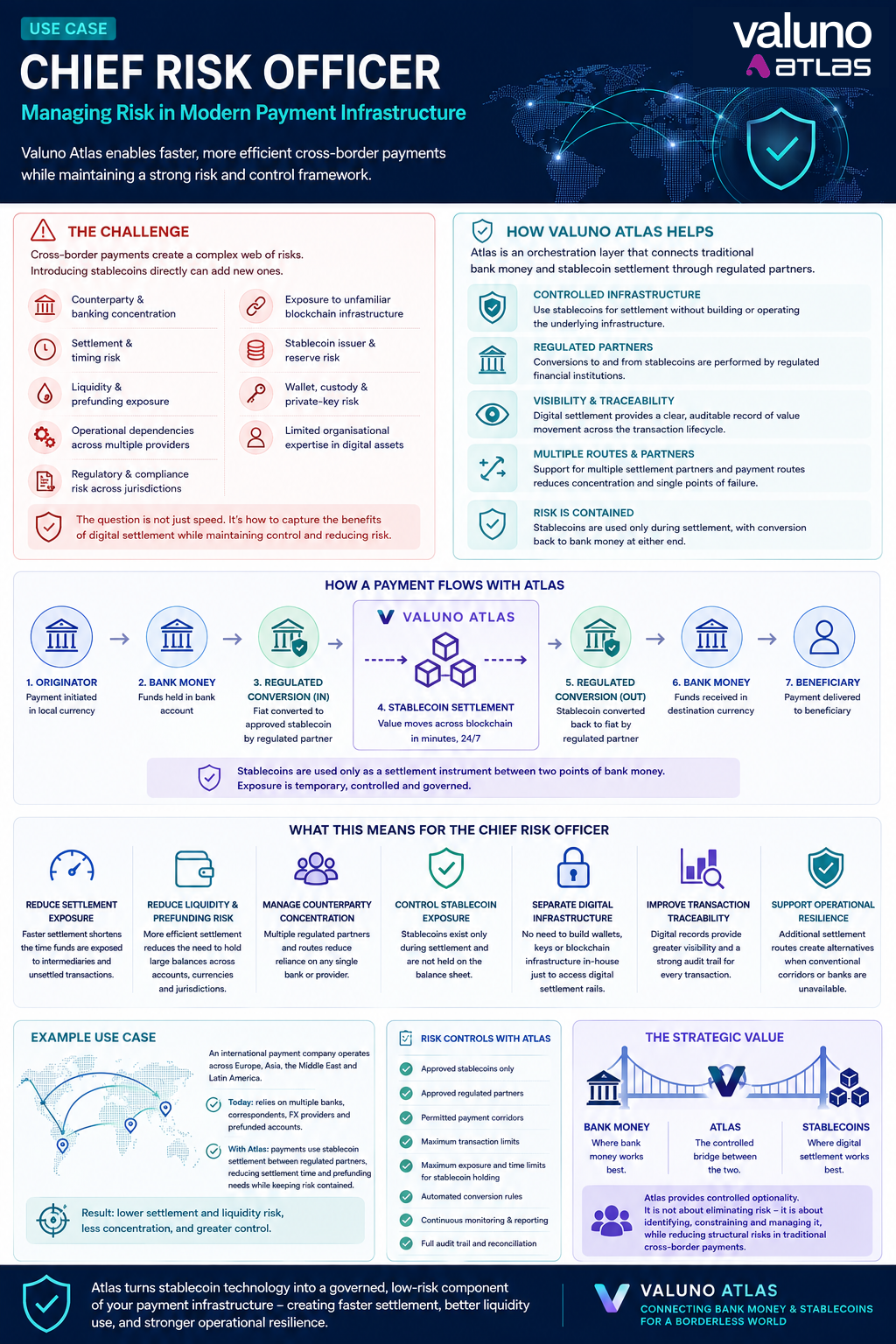
Reducing risk in cross-border payment infrastructure
For a Chief Risk Officer, modernising payments creates a fundamental trade-off. The organisation wants faster settlement, broader geographic reach and more efficient liquidity – but every new payment rail, provider and technology can introduce additional counterparty, operational, compliance and financial risk.
Talk to us about ATLASValuno ATLAS provides a controlled infrastructure layer between traditional bank money and stablecoin settlement – allowing organisations to use digital settlement rails without having to build and operate the underlying stablecoin infrastructure themselves.
The question is therefore not simply whether stablecoins can make payments faster. It is how the organisation can capture the benefits of digital settlement while maintaining an appropriate risk and control framework.
Cross-border payments already create a complex risk environment. Funds may pass through several banks, payment providers, currencies and jurisdictions before reaching the beneficiary. At the same time, introducing stablecoins directly can create an entirely new set of risks.
Counterparty and banking concentration risk
Settlement and timing risk
Liquidity and prefunding exposure
Operational dependencies across multiple providers
Regulatory and compliance risk across jurisdictions
Exposure to unfamiliar blockchain infrastructure
Stablecoin issuer and reserve risk
Wallet, custody and private-key risk
Limited organisational expertise in digital-asset operations
ATLAS acts as an orchestration layer between the organisation, regulated financial partners, stablecoins and blockchain settlement infrastructure. Rather than requiring the organisation to establish and operate every component itself, ATLAS provides a controlled architecture for connecting them.
Use stablecoins for settlement without building or operating the underlying infrastructure.
Conversions to and from stablecoins are performed by regulated financial institutions.
Digital settlement provides a clear, auditable record of value movement across the transaction lifecycle.
Support for multiple settlement partners and payment routes reduces concentration and single points of failure.
Stablecoins are used only during settlement, with conversion back to bank money at either end.
Bank money → Regulated conversion → Stablecoin → Blockchain settlement → Regulated conversion → Bank money
Originator
Payment initiated in local currency
Bank money
Funds held in a bank account
Regulated conversion (in)
Fiat converted to an approved stablecoin by a regulated partner
Stablecoin settlement
Value moves across blockchain in minutes, 24/7
Regulated conversion (out)
Stablecoin converted back to fiat by a regulated partner
Bank money
Funds received in destination currency
Beneficiary
Payment delivered to the beneficiary
Stablecoins are used only as a settlement instrument between two points of bank money. Exposure is temporary, controlled and governed — a temporary settlement instrument rather than a permanent balance-sheet asset.
Faster settlement shortens the period during which funds are exposed to intermediaries and unsettled transactions.
More efficient settlement can reduce the need to maintain large balances across multiple banks, currencies and jurisdictions.
An orchestration architecture can support multiple regulated settlement partners and payment routes rather than creating unnecessary dependency on a single provider.
Stablecoins can be used specifically for the settlement stage, with conversion into and out of bank money at either end of the transaction.
The organisation does not need to build its own blockchain, wallet and conversion infrastructure simply to access digital settlement rails.
Digital settlement can provide stronger transaction-level visibility and an auditable record of movement across the settlement process.
Additional settlement routes can create alternatives when conventional payment corridors, banks or intermediaries are unavailable or inefficient.
For the Chief Risk Officer, the important distinction is between holding stablecoins as an asset and using stablecoins as settlement infrastructure. ATLAS is designed around the second model. This makes it possible to establish explicit policies around:
Consider an international payment company processing transactions across Europe, Asia, the Middle East and Latin America.
Today
With ATLAS
Instead of replacing the existing banking infrastructure, ATLAS adds another potential route for moving value.
For the Chief Risk Officer, ATLAS provides a way to approach payment innovation through controlled optionality. Traditional banking rails remain available. Stablecoin settlement becomes an additional rail. Regulated partners provide the conversion points between the two. And ATLAS provides the orchestration layer connecting them.
Bank money
Where bank money works best.
ATLAS
The controlled bridge between the two.
Stablecoins
Where digital settlement works best.
The result is not the elimination of risk – no payment infrastructure can provide that. It is the ability to identify, constrain and manage the risks associated with digital settlement while potentially reducing some of the structural risks inherent in traditional cross-border payments. ATLAS can therefore become part of the organisation’s existing risk framework rather than creating a parallel financial system outside it.
CFO
Unlock working capital, reduce costs and gain control over global payments
Corporate Treasurer
Real-time control of global liquidity
Head of Payments
Modernising cross-border payment infrastructure
Chief Compliance Officer
Compliance by design for modern payments
CEO
Building a faster, smarter and more resilient payments infrastructure
Tell us about your payment flow and we’ll show you how ATLAS can connect the right rails.
Contact us