Use case · Valuno ATLAS
ATLAS for CFOs
Unlock working capital, reduce costs and gain control over global payments
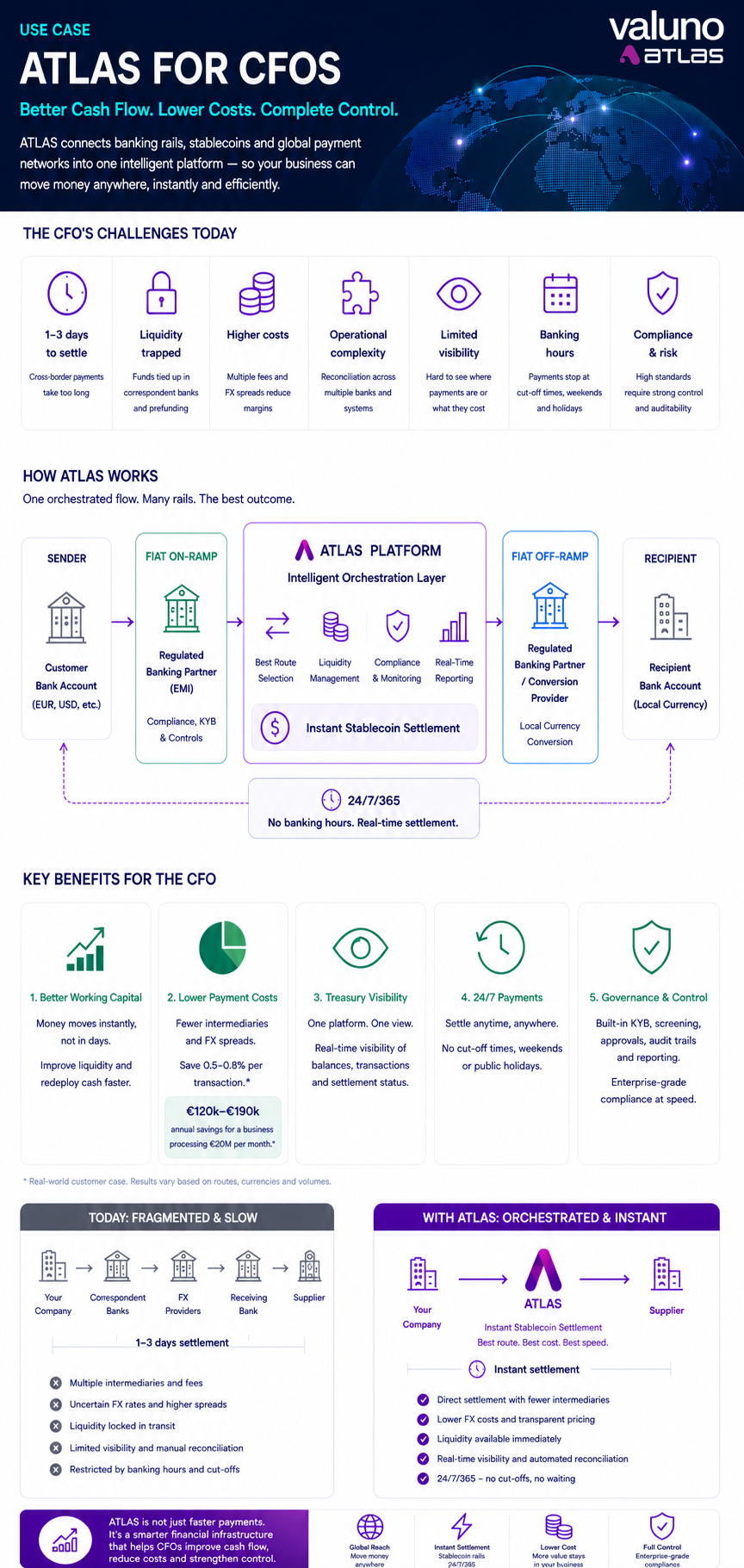
Every CFO faces the same challenge: the business operates in real time, but cash often does not. International payments still move through multiple banks, correspondent networks, foreign exchange providers and reconciliation systems. The result is trapped liquidity, delayed settlement, unnecessary FX costs, operational complexity and limited visibility into where cash actually is.
Talk to us about ATLAS While production, sales and supply chains have become increasingly digital, the infrastructure that moves money internationally has changed far more slowly.
ATLAS was built to solve this problem—not by replacing banks, but by connecting traditional banking infrastructure, stablecoins and blockchain settlement into one intelligent payment platform. Rather than forcing every payment through a predetermined banking route, ATLAS orchestrates the entire transaction, selecting the most appropriate combination of banking rails, liquidity providers and settlement methods for each payment.
For the CFO, the value is not blockchain technology itself. The value lies in better cash flow, lower payment costs, improved liquidity utilisation and greater financial control.
The CFO’s challenges today
Today, a typical cross-border payment may pass through several correspondent banks, foreign exchange providers and local banking systems before reaching its destination. During this journey, funds are tied up, payment status may be difficult to track, multiple parties add fees, and treasury teams must reconcile transactions across several systems.
Cross-border payments take too long.
Funds tied up in correspondent banks and prefunding.
Multiple fees and FX spreads reduce margins.
Reconciliation across multiple banks and systems.
Hard to see where payments are or what they cost.
Payments stop at cut-off times, weekends and holidays.
High standards require strong control and auditability.
How ATLAS works
One orchestrated flow. Many rails. The best outcome.
01 Sender
Payment initiated from the customer bank account (EUR, USD, etc.)
→
02 Bank money in
Funds held with a regulated banking partner
→
03 Regulated conversion
Fiat converted to an approved stablecoin by a licensed partner
→
04 ATLAS settlement
Value moves across blockchain infrastructure in minutes, 24/7
→
05 Regulated conversion
Stablecoin converted back to local fiat
→
06 Bank money out
Funds delivered through the local banking rail
→
07 Recipient
Payment arrives in the recipient bank account
ATLAS simplifies this process by providing a regulated fiat on-ramp through banking partners, converting funds into stablecoins where appropriate, settling them instantly across blockchain networks and converting them back into local currency before delivering them directly into the recipient’s bank account. To the customer, the payment still appears as a normal bank transfer. Behind the scenes, however, the settlement infrastructure has been fundamentally modernised.
Key benefits for the CFO
01 Working capital improves
Money no longer spends several banking days travelling through intermediary institutions. Settlement can occur almost instantly, allowing liquidity to become available much sooner. Instead of cash remaining trapped while payments are processed, it can be redeployed into the business more quickly, improving overall liquidity management.
02 Payment costs fall
Every intermediary in a traditional payment chain typically adds fees, foreign exchange spreads or operational overhead. By reducing the number of intermediaries and optimising the settlement path, ATLAS lowers the overall cost of moving money internationally.
03 Treasury gains visibility and control
Instead of managing several banking portals, wallet providers and payment systems independently, treasury teams receive a consolidated view of balances, transactions, counterparties and settlement status. ATLAS combines wallet management, compliance, settlement and real-time reporting within one platform, making cash management more transparent and reducing operational complexity.
04 Payments are no longer constrained by banking hours
Traditional cross-border payments frequently wait for daily processing windows, weekends or public holidays before moving. Businesses, however, increasingly operate around the clock. ATLAS enables settlement twenty-four hours a day, seven days a week, allowing companies to respond immediately to urgent supplier payments, time-sensitive trading opportunities or changing liquidity requirements.
05 Governance remains at enterprise level
Faster payments should never come at the expense of financial control. ATLAS incorporates customer and business verification, wallet screening, sanctions controls, approval workflows, transaction monitoring, audit trails and real-time reporting into the payment process itself. This allows CFOs to benefit from faster settlement while maintaining the governance, compliance and internal controls expected within modern treasury operations.
€120,000–190,000
annual savings
In one real-world customer example presented by Valuno, a business processing approximately €2 million in monthly cross-border payments reduced conversion costs by between 0.5 and 0.8 percentage points.
Real-world customer case. Results vary based on routes, currencies and volumes.
Example use case
Consider a European manufacturer paying suppliers across Latin America, Asia and the Middle East.
Today
- Treasury may need to instruct payments through several banks
- Wait for correspondent banking networks to process the transactions
- Monitor multiple foreign exchange conversions
- Reconcile payments across several systems before funds are finally received
With ATLAS
- Treasury initiates one payment
- Funds enter through a regulated banking partner
- Settle almost instantly using stablecoins where appropriate
- Convert back into local currency and arrive in the supplier’s bank account through the most efficient local banking infrastructure
Treasury maintains full visibility throughout the process while the underlying complexity remains invisible to the business.
Orchestration, not a single rail
Perhaps the most important difference between ATLAS and many other payment platforms is that it is built around orchestration rather than a single payment rail. The future of payments will not rely exclusively on banks, stablecoins or blockchain. These infrastructures will coexist, each serving different purposes. The competitive advantage lies in intelligently selecting the most appropriate route for every transaction.
Bank money
Where bank money works best.
ATLAS
The orchestration and control layer.
Stablecoins
Where digital settlement works best.
Ultimately, ATLAS is not simply a faster way to move money. It is a new financial infrastructure that helps CFOs optimise working capital, reduce payment costs, improve liquidity utilisation and strengthen treasury operations without abandoning the security and regulatory framework of traditional banking.
Ready to explore ATLAS?
Tell us about your payment flow and we’ll show you how ATLAS can connect the right rails.
Contact us