


Connect
Seamlessly connects fiat currencies, stablecoins and regulated settlement partners.

Use case · Valuno ATLAS
Modernising cross-border payment infrastructure
For a Head of Payments, the challenge is no longer simply moving money from A to B. The role increasingly involves balancing speed, cost, liquidity, regulatory requirements, operational resilience and customer expectations across a fragmented landscape of banks, payment networks, currencies and jurisdictions.
Talk to us about ATLASValuno ATLAS provides a new infrastructure layer for moving value internationally – combining the reach and programmability of stablecoins with regulated access to traditional bank money.
Stablecoins can address some of these limitations by enabling near-instant, 24/7 transfer of value. But most companies do not want to become crypto infrastructure operators themselves. They need stablecoins to connect seamlessly with the banking system.
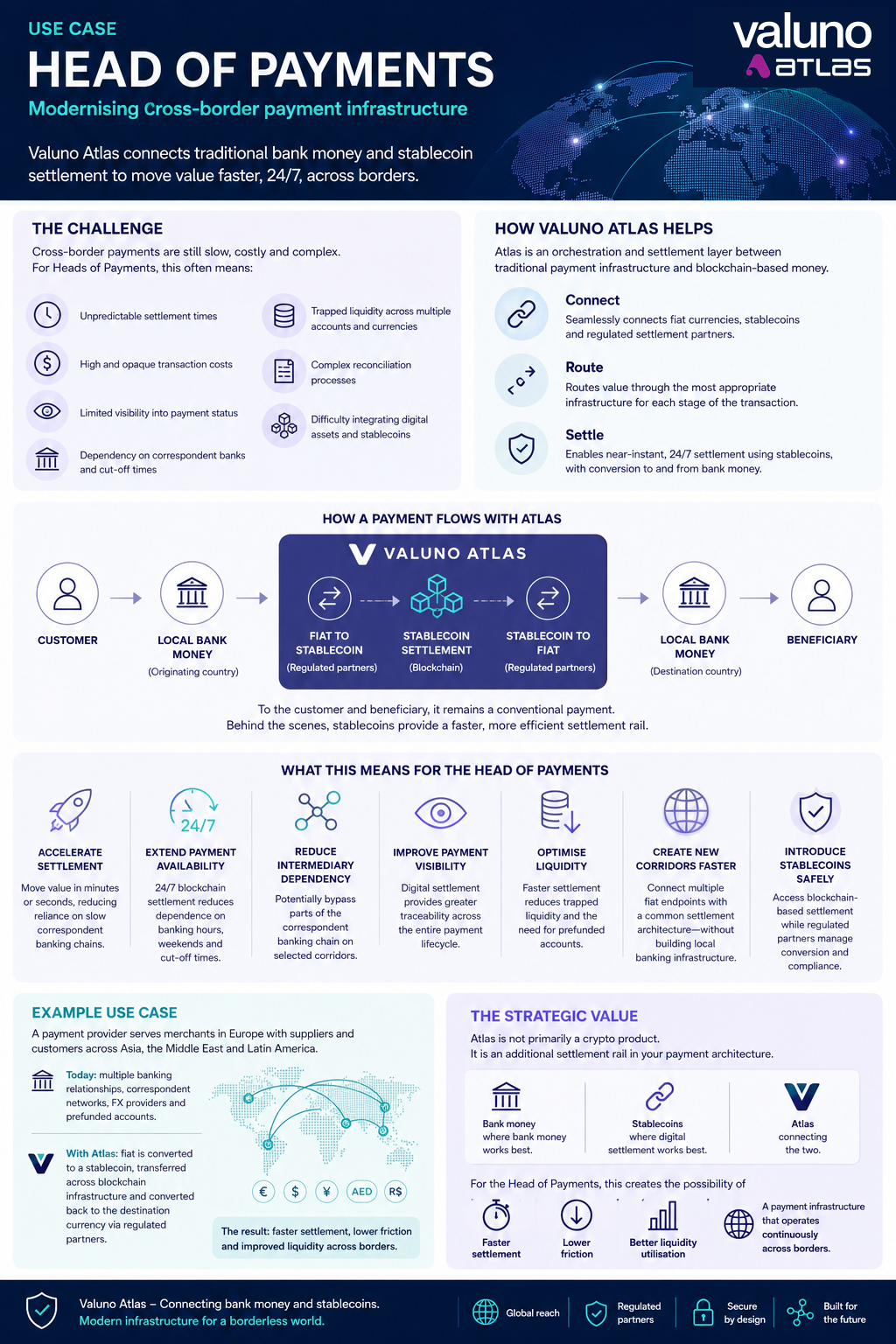
Cross-border payments still frequently depend on correspondent banking chains, multiple intermediaries and separate systems for messaging, settlement, FX and reconciliation. For the Head of Payments, this can mean:
Unpredictable settlement times
High and sometimes opaque transaction costs
Limited visibility into payment status
Dependency on correspondent banks and cut-off times
Trapped liquidity across multiple accounts and currencies
Complex reconciliation processes
Difficulty integrating digital assets and stablecoins into existing payment operations
ATLAS acts as an orchestration and settlement layer between traditional payment infrastructure and blockchain-based money. Instead of requiring the organisation to build its own stablecoin infrastructure, establish multiple blockchain integrations or redesign its payment architecture, ATLAS provides a controlled route between fiat currencies, stablecoins and regulated settlement partners.
Seamlessly connects fiat currencies, stablecoins and regulated settlement partners.
Routes value through the most appropriate infrastructure for each stage of the transaction.
Enables near-instant, 24/7 settlement using stablecoins, with conversion to and from bank money.
Customer → Local bank money → ATLAS → Stablecoin settlement → ATLAS → Local bank money → Beneficiary
Customer
Payment initiated in the originating country
Local bank money
Funds held in the originating market
Fiat to stablecoin
Conversion by regulated partners
Stablecoin settlement
Value moves across blockchain infrastructure
Stablecoin to fiat
Conversion by regulated partners
Local bank money
Destination country banking rail
Beneficiary
Payment received in local currency
The stablecoin becomes a settlement rail rather than something the corporate customer or beneficiary necessarily needs to hold or manage. To the customer and beneficiary, it remains a conventional payment.
International value can move across blockchain infrastructure in minutes or seconds rather than depending entirely on traditional correspondent banking chains.
Blockchain settlement operates 24/7, reducing dependence on banking hours, weekends and international cut-off times.
Selected payment corridors can potentially bypass parts of the traditional correspondent banking chain.
Digital settlement provides greater traceability of where value is within the transaction lifecycle.
Faster settlement can reduce the amount of working capital that needs to remain distributed across currencies, accounts and payment providers.
Rather than establishing a complete banking infrastructure for every market, ATLAS can provide a common settlement architecture connecting multiple fiat endpoints.
The organisation can gain access to blockchain-based settlement while ATLAS and its regulated partners handle the underlying conversion and settlement infrastructure.
Consider a payment provider serving merchants in Europe whose suppliers and customers operate across Europe, Asia, the Middle East and Latin America.
Today
With ATLAS
Behind the scenes, however, the settlement architecture has changed.
For the Head of Payments, ATLAS is therefore not primarily a crypto product. It is a way of introducing an additional settlement rail into the organisation’s payment architecture. Traditional banking rails remain important. Stablecoins do not have to replace them. Instead, ATLAS allows the payment function to determine which infrastructure is most appropriate for each transaction, corridor and liquidity requirement.
Bank money
Where bank money works best.
ATLAS
Connecting the two.
Stablecoins
Where digital settlement works best.
For the Head of Payments, that creates the possibility of faster settlement, lower friction, better liquidity utilisation and a payment infrastructure capable of operating continuously across borders.
CFO
Unlock working capital, reduce costs and gain control over global payments
Corporate Treasurer
Real-time control of global liquidity
Chief Risk Officer
Reducing risk in cross-border payment infrastructure
Chief Compliance Officer
Compliance by design for modern payments
CEO
Building a faster, smarter and more resilient payments infrastructure
Tell us about your payment flow and we’ll show you how ATLAS can connect the right rails.
Contact us